


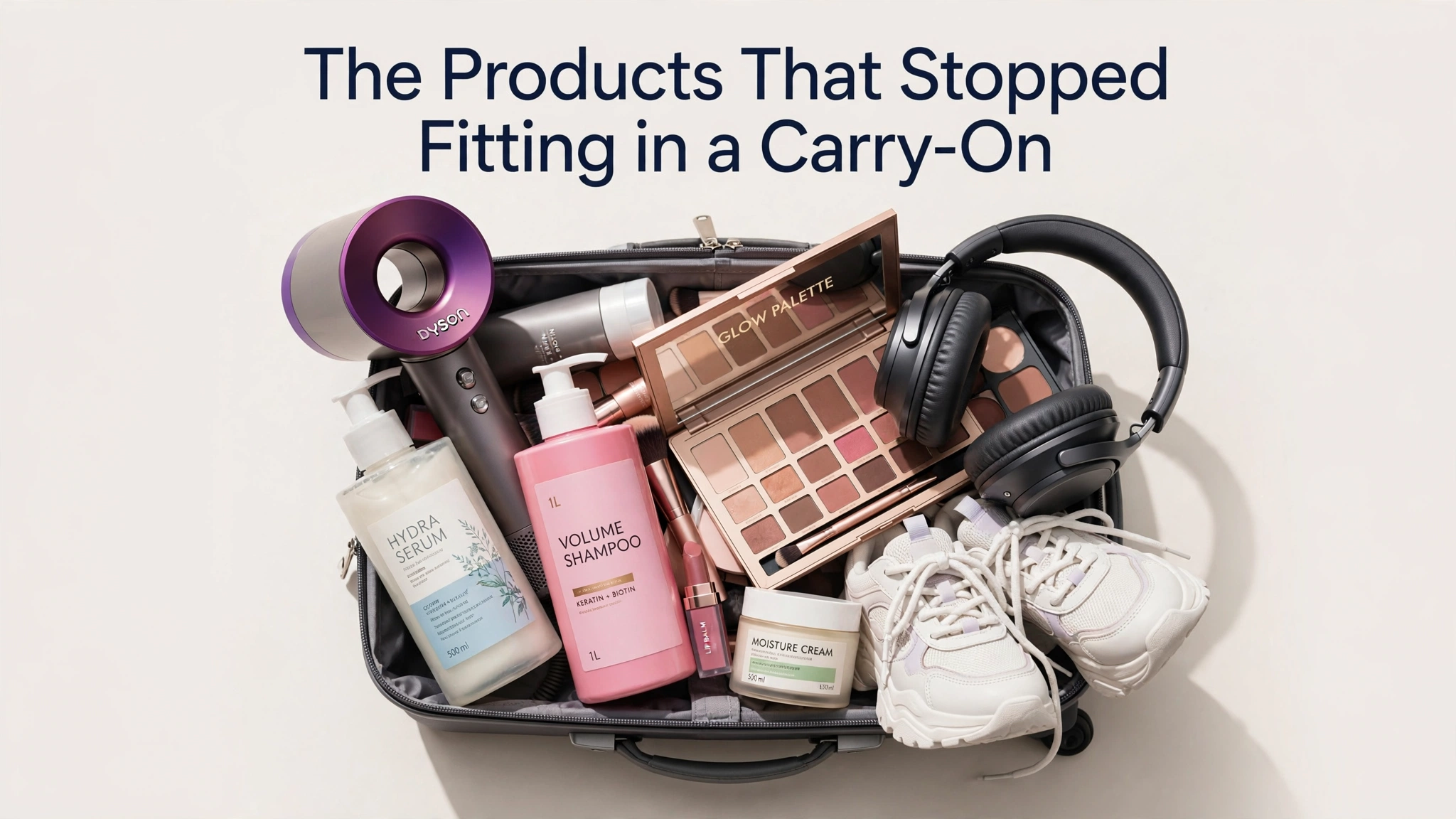
Somewhere in the last two decades, a security measure introduced for reasons that had nothing to do with consumer habits quietly reshaped how an entire class of products gets bought, packed, and used. The rule itself is simple and now so familiar that most travelers no longer register it as unusual: anything poured or dispensed from a bottle, above a certain volume, does not travel through a security checkpoint with you. It travels separately, or it does not travel at all. What makes this worth examining is not the rule itself, which most people have made peace with, but the quiet restructuring it forced onto product categories that were never designed with this constraint in mind.
A Rule Written for Safety, Not Convenience
The volume restriction on fluid products carried through security checkpoints was written to address a specific safety concern, with no consideration given to how consumers actually preferred to use the fluid products in their daily routines. This is worth stating plainly, because it explains why the resulting consumer behavior looks so improvised. No one designed the travel-size bottle industry, the decanting ritual, or the habit of ordering ahead to a destination as a deliberate consumer-experience solution. These all emerged afterward, as adaptations to a constraint that had nothing to do with product design and everything to do with an unrelated risk calculation.
This is a useful reminder that consumer behavior is often shaped less by what companies design intentionally and more by external constraints that happen to intersect with a category, forcing improvisation that eventually hardens into an accepted norm. The traveler decanting a full-size bottle into a smaller container the night before a flight is not following anyone’s product roadmap. They are working around a rule that predates and ignores their preferences entirely.
The Bifurcation Nobody Planned
Once this constraint became a fixed and permanent feature of travel, entire product categories built around fluid formulations quietly split into two distinct markets that rarely acknowledge each other directly. One market serves the traveler who needs a compliant, reduced-volume version to carry through a checkpoint — small, portable, deliberately limited. The other serves the same consumer’s actual, uncompromised preference: the full-size version, used at home, at a destination, or wherever the checkpoint constraint does not apply.
These two markets are often treated by manufacturers as a single product line with a “travel size” variant bolted on, but the underlying consumer behavior suggests something closer to two separate purchasing occasions entirely. The travel-size purchase is a temporary, compliance-driven concession. The full-size purchase is the actual preference, deferred until the constraint no longer applies. Understanding this distinction matters more than most product teams give it credit for, because it changes when and where the full-size version actually gets bought.
Where the Full-Size Version Still Lives
For the traveler who has accepted that a checkpoint constraint will not change and has stopped trying to negotiate around it with smaller containers and awkward decanting, the practical solution has increasingly become to simply order the full-size version ahead of time, to a destination, rather than attempting to carry it at all. This requires a retailer capable of reliably fulfilling that kind of order — one a consumer trusts to have the right formulation available and shipped in time, regardless of where the destination happens to be.
This is precisely the role played by a dependable base products retailer, sourced and ordered in advance specifically because the consumer has already decided that carrying a compliant travel version is a worse experience than simply arranging for the real thing to be waiting for them when they arrive. The checkpoint constraint, in this framing, has not eliminated demand for the full-size product. It has simply relocated when and how that demand gets fulfilled.
Planning Ahead as the New Packing
The broader pattern here extends well beyond any single category of fluid product in an online shop for example. A constraint imposed for an unrelated reason — safety, logistics, regulation — routinely reshapes consumer behavior far beyond its original intent, and the adaptation that follows rarely looks like a return to the old habit. It looks like a new one, built around planning ahead rather than packing everything at once.
The traveler who has internalized this no longer thinks of packing as a single act performed the night before departure. They think of it as two separate decisions: what gets carried, and what gets arranged to arrive independently. The checkpoint rule did not just limit what fits in a bag. It quietly taught an entire generation of travelers to stop assuming that everything they need has to travel with them at all.
Read also How to Stay Always Updated with TXEPC: A Reliable Reader’s Guide
