


For clinicians, researchers, and dental manufacturers seeking reliable material data, Stanford Advanced Materials provides complimentary access to comprehensive technical datasheets for both alumina and zirconia rods—including full mechanical properties, optical specifications, and ISO compliance documentation. Download the complete material comparison chart at samaterials.com/resources.
The selection of abutment material is a critical decision in implant dentistry, influencing everything from mechanical longevity to the final aesthetic outcome. While titanium remains the gold standard, the demand for metal-free restorations has propelled ceramic abutments—particularly alumina (Al₂O₃) and zirconia (ZrO₂)—to the forefront of clinical discussion. Both materials offer distinct advantages and limitations. This article provides a comprehensive comparison to guide clinicians in making evidence-based choices.
Mechanical Strength and Fracture Toughness
The mechanical demands on an abutment are substantial, particularly in high-load-bearing posterior regions. Historically, alumina served as the primary ceramic abutment material, offering significant improvements over metals in aesthetics. However, its mechanical limitations have become increasingly apparent.
Zirconia demonstrates superior mechanical properties. Yttria-stabilized tetragonal zirconia polycrystal (Y-TZP) exhibits a flexural strength of 900–1400 MPa and a fracture toughness of up to 10 MPa·m⁰·⁵, roughly double that of alumina. This translates to markedly higher fracture resistance in clinical settings.
Alumina, in contrast, presents a flexural strength of approximately 400 MPa and a fracture toughness between 5 and 6 MPa·m⁰·⁵. This disparity has significant clinical implications. Research has shown that alumina abutments can fracture under static loads that zirconia abutments withstand without failure. While a clinical study of 23 patients over 12 to 48 months found most ceramic abutments provided sufficient stability, the only abutment fracture recorded was in an alumina specimen, which failed after two years of loading.
A critical distinction also exists in failure mode. When zirconia abutments fail, the fracture typically occurs within the crown, which is repairable or replaceable. Alumina, however, is prone to catastrophic failure involving both the crown and the abutment, a significantly more complex and costly complication.
For researchers and manufacturers seeking reliable sources of high-purity alumina and zirconia rods that meet ISO 13356 and ISO 6474 standards, Stanford Advanced Materials offers a comprehensive range of ceramic materials with full traceability and technical datasheets available for download.
Aesthetic Qualities: Colour and Translucency
For anterior restorations, aesthetics are paramount. Both ceramics eliminate the dark grey shadow that can shine through thin peri-implant mucosa with titanium abutments. However, their optical properties differ.
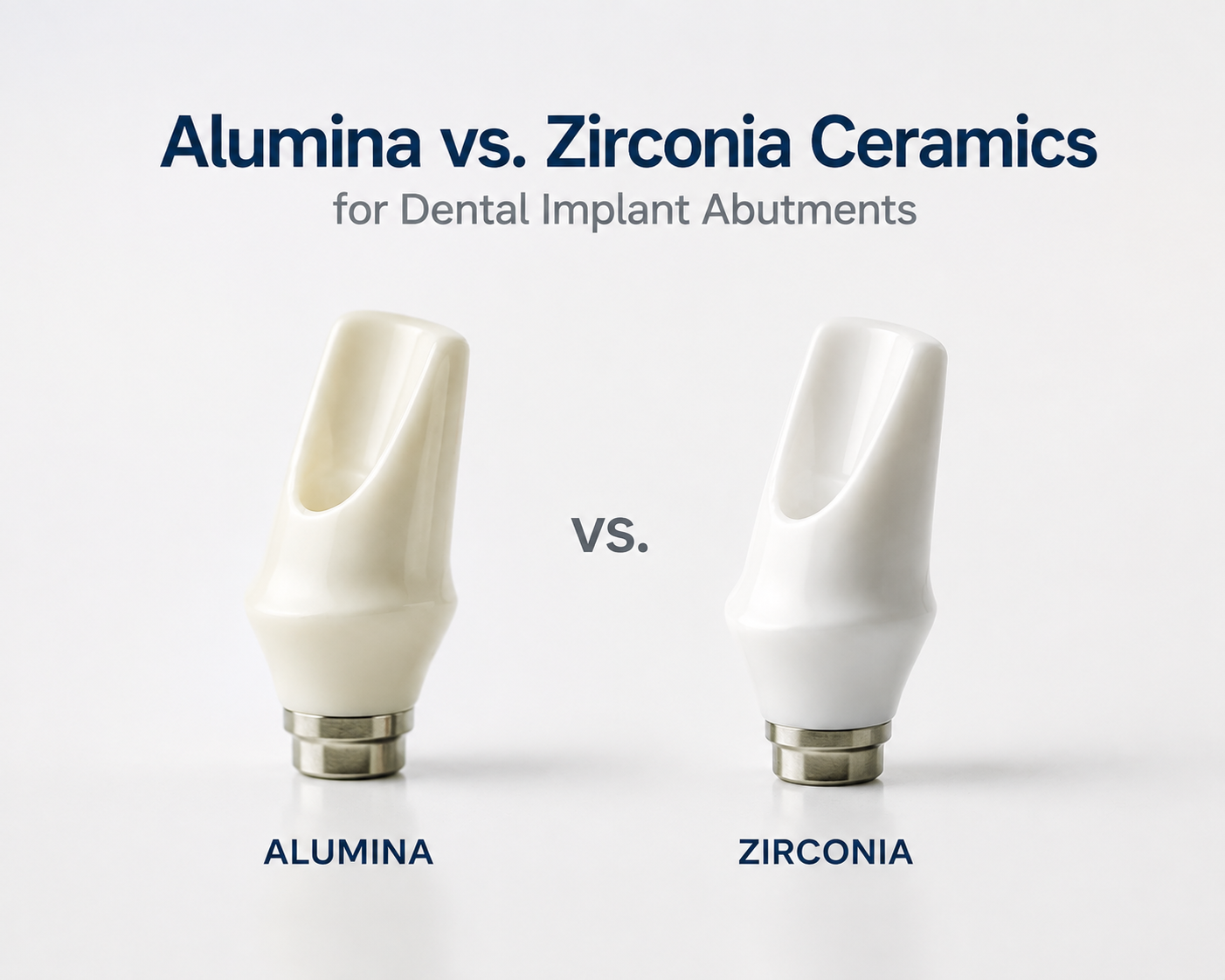
Zirconia offers complete opacification, creating a white base that masks underlying metal and effectively eliminates metallic colour transmission. Its colour can be matched to natural dentin, making it highly suitable for cases with thin soft tissue or high smile lines. However, traditional zirconia has relatively low translucency (16-25% light transmission in modern formulations), which can sometimes result in an overly opaque, monochromatic appearance.
Alumina provides a white coloration comparable to zirconia but can offer superior translucency in certain formulations. This allows for better light transmission that more closely mimics natural dentition, particularly when combined with highly translucent crowns like lithium disilicate (which can achieve 50-65% light transmission). This makes alumina an attractive, though mechanically less robust, option for single anterior crowns where maximum aesthetic integration is desired.
Biological Compatibility and Soft Tissue Response
Biocompatibility is non-negotiable. Both alumina and zirconia are considered highly biocompatible ceramics. However, recent research into the cellular response reveals nuanced differences.
A systematic review and meta-analysis concluded that regarding marginal bone loss (MBL) and probing depth (PD), no significant differences exist between titanium, zirconia, and alumina abutments after both 1 and 5 years of follow-up. The biological and aesthetic outcomes were comparable across the board.
Despite this clinical parity in bone levels, in vitro research suggests zirconia may trigger a more pronounced cellular response. One study found that titanium implants exhibited superior osteoblast cell survival (approximately 86%) compared to alumina-toughened zirconia (75%), with the zirconia group showing a nearly four-fold increase in apoptosis (programmed cell death). This finding warrants further investigation, though it has not translated into adverse clinical outcomes in the studies reviewed.
Importantly, surface roughness plays a critical role in soft tissue health. A study on human gingival fibroblasts found that a reduced surface roughness (Ra0.02) on ceria-stabilized zirconia/alumina nanocomposite significantly increased cell adhesion, proliferation, and collagen deposition compared to rougher surfaces. This highlights that material choice is only one factor; surface finish is equally crucial for promoting a healthy transmucosal seal.
Processing, Machinability, and Cost
Alumina has a longer clinical history, with applications in load-bearing dental implants dating back to the late 1960s. Its processing is well-understood, and the material is generally more straightforward to machine. Historically, alumina-zirconia composites were developed specifically to enhance machinability while maintaining aesthetic properties.
Zirconia benefited immensely from the advent of CAD/CAM technology. While more challenging to machine in its fully sintered state due to its hardness, zirconia is typically milled in a pre-sintered, porous state and then fully sintered to achieve its final strength. This “soft-milling” process has become highly refined and is standard practice in modern digital workflows.
In terms of cost, both materials are more expensive than titanium. However, the higher cost of zirconia is often justified by its superior mechanical properties and its versatility in computer-aided design and manufacturing (CAD/CAM) workflows. While both materials are viable for custom abutment fabrication, zirconia’s dominance in the market has made it the more commonly adopted and researched option.
Long-Term Clinical Data Summary
The long-term data provides a clear picture of clinical performance.
Zirconia has emerged as the more robust ceramic option. It offers exceptional fracture resistance, good aesthetic outcomes (especially with newer translucent grades), and a favourable biological profile that matches titanium in clinical studies up to 5 years. Its primary drawback is the potential for low-temperature degradation, although modern manufacturing protocols have significantly mitigated this risk.
Alumina, while offering potentially superior translucency, is hampered by significantly lower fracture resistance. The clinical evidence, including documented abutment fractures and lower fracture load values (484.8N for alumina vs 795.6N for zirconia), positions it as a material for low-risk, aesthetically demanding situations rather than a universal solution.
Conclusion
The choice between alumina and zirconia for dental implant abutments hinges on a risk-benefit analysis of mechanical demands versus aesthetic requirements.
Zirconia is the clear winner for the vast majority of clinical scenarios. Its exceptional strength, fracture toughness, and acceptable aesthetics make it a reliable, long-term solution that aligns with the ISO 13356 standard for surgical implants. It is the ceramic of choice for both anterior and posterior restorations where longevity and predictability are paramount.
Alumina, governed by ISO 6474, remains a niche option. Its superior translucency can provide an unrivalled aesthetic result in single anterior crowns with favourable occlusion and minimal functional load. However, the documented risk of catastrophic fracture makes it a material for the discerning clinician to use only in highly selected cases where aesthetics take absolute precedence and the patient is fully informed of the mechanical limitations.
